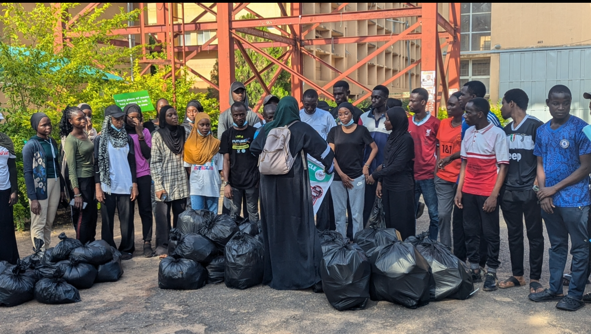

The International Environment Roundtable for Africa (IERA) took place last week Thursday, 1st September. Co-founder of Green Habitat Abdulmumin Tanko and I (Sadiq) joined fellow environmentalists from Nigeria and other African countries at the event organized by GreenLife Magazine in Nigeria’s capital city, Abuja. The theme of the one day event centered on “curbing environmental degradation & climate change through activism.” The conference organizer has gathered the Honourable Minister for State on Environment Ibrahim Usman, the coordinator UNEP climate change Programme in person of Dr Richard Munang, and other notable people to raise their voice on how environmentalism should be done in the country.

Two discussions were held as part of the event. The first was with a group of students from neighbouring Universities of Abuja, Nassarawa and Minna tagged the African Environment Town Hall. The students discussed how government can step up dedication and efforts to fight environmental degradation. The key areas where the discussants felt the government can do more are on waste disposal, afforestation programmes and early environmental education. It was important to listen to them understand how environmental policies can improve our environment. I 100% agree on their deliberations, especially on early environmental education.
The main discussion of the day had 6 people on the table. Mr Uche Agbanusi, the former president of the Nigerian Environmental Society (NES), Dr Richard Munang, the Minister of State for Environment, Dr Newton Jibunoh of Fight Against Desert Encroachment (FADE) Foundation and the Deputy Director of Environmental Protection Agency of Ghana, Mr Appiah.
Aggregating the 2 different discussions of the day, these are the lessons and messages that made the strongest call.
Activism: start early and start now
It is not that it has not started, but environmental activism needs to increase. African (environmental) activism needs to dream bigger, echoed Dr. Munang. Sensitization must increase in order for the local people living in villages not to continue cutting down trees to make charcoal and sell on the roads. Deforestation can be disastrous in many ways. Africa as a continent is losing $68 billion annually to land degradation. People ought to know the harmful effects of climate change, reiterated the Minister. Quite frankly, if many people become aware of their actions on the environment and the corresponding effect, they will be moved to change their actions. If one tree is cut down, what is lost? Programmes discouraging deforestation must translate all results of cutting down a tree to the people.
Dr. Munang comprehensively answered the follow up question on how big we can dream. “It is not just about going from door to door and organizing seminars. Government policies should also encourage environment friendly acts.” Such policies for instance can mean giving tax incentives to companies providing renewable energy solutions such as 0% VAT. Although, a proper framework must be put in place for ideas like these to flourish. The government and all other key stakeholders must act together to improve and make such guidelines, reiterated Mr. Appiah.
If we do not act now, we will always be playing the catch up game.
Define an Effective Communication Strategy
How do you explain climate change to someone who does not know what climate is? Most environmental NGOs get it wrong when communicating climate change says the former president of NES. Take erosion for instance. In a typical geography or environmental science class, the teacher can simply mention desert encroachment and erosion to be exacerbated by climate change. This may not be easily communicated to a layman but what can and should be said is something peculiar and comprehendible to them. A discussant mentioned that erosion can be explained by pointing to a building whose earlier buried foundation has now become exposed because the sands have been washed away.
The communication strategy is key and should be clearly spelt out in order to make impact. Inform them where you are going with your activism, why you are doing it, what you are doing and other basic but important questions. The local people have to be carried along and should be made to see and understand the whole process involved. They shouldn’t be left in the dark.
Localize Environmental Activism
Solutions from abroad cannot work for most African cities, Ibrahim Usman stated. Africa and Nigeria have peculiar problems that need local innovations and actions. Even in Nigeria, the challenges in Abuja are to some extent different from those in other states. It is therefore important that when environmentalists communicate environmental protection and conservation to local people, they should speak of how the environment affects the local people.

The event rounded up by the organizers honouring some people in their quest for environmentalism. Mr Richard Munang was awarded the African Environment Hero Award, Dr Newton Jibunoh got the Environment Legacy Award for his work on desertification. The Nigerian Television Authority was awarded the (environment) TV channel for screening two TV programmes on environment every week. Sterling Bank got award for its Corporate Social Responsibility .
Generally, the discussions were fruitful and added dedication to how serious Nigeria is on fighting climate change. But the main act is translating the talk into action. What are you doing to protect the environment?
 Sadiq Abubakar Gulma steers the organizational mission of Green Habitat. He is a member of the Green Talents International Forum for High Potentials in Sustainable Development, a LEED accredited green building professional and has a master’s degree in Environmental Engineering. His research interest and work lie in investigating and improving the thermal conditions of urban built environments. Follow him on Twitter @TheCivineer