
Glaciers are large bodies of compressed snow on the land surface, which store about three-quarters of Earth’s freshwater. They play an important role in maintaining balance within ecosystems by supplying cold streams during dry seasons upon which various plants and animals depend. Scientists around the world have been studying glacial changes over the years and how that might affect ecosystems and the environment. Some findings from these studies may have astounding implications.
Reevaluation of global glacier mass
A recent Atlas study by the Institute of Environmental Geosciences and Dartmouth College revealed that there is less water and ice in the global glacier than previously presumed. The latest research indicates that the global glacier consists of about 20% less ice and freshwater than previously estimated. For example, the South American tropical Andes has about a quarter less ice than the scientists thought it has.
This new insight means that the melting of glaciers due to global warming won’t have as much negative impact on the current sea level as predicted before. It will, in fact, have a positive
implication on the freshwater and vegetation but concern remains. Mathieu Morlighem, a professor of earth science at Dartmouth College and a climate scientist who authored the research, stated that very little is known about the glaciers we have in the mountains as there are about 200,000 of them distributed around the globe and it is notoriously difficult to predict their future. Moreover, our understanding of their size, geometry, and thickness is very limited.
Billions of tons of ice are lost every year and the amount of ice lost is greater than the amount of ice reformed. The fate of the melting glaciers depends on where it is located. According to Stephen Singer, a senior Climate Science and Global Energy Policy Advisor, the Ice melting in Greenland or the Arctic is a loss, because it ends up in the sea and mixes with the seawater, which is not consumable. However, Himalayan glaciers are one of the biggest sources of water for agriculture, forestry, and other ecosystem services.
The implication of accelerated glacier melting
In a separate study that was published in Nature’s journal of Scientific Reports back in December, the Himalayan glaciers were observed to be undergoing rapid ice loss that is 10 times faster in the past four decades than in the previous seven centuries. Communities around these mountains rely on the fresh water from the glaciers for agriculture and household needs; the loss will impact the livelihood of millions of people.
As there is even less ice on the mountains, Matthieu Morlighem worries that the communities relying on the glaciers as their main source of fresh water will have to adapt to the new development and rely on other sources for their supply of water, especially during the dry seasons. He added that our hope is for policymakers to take these new numbers into account and revise the way we do things today. One way to achieve that is by cutting down carbon emissions to keep the global temperature within reasonable limits.
The collapse of ice shelves in Antarctica
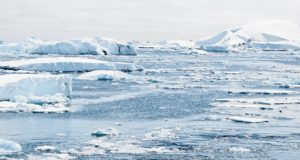
Another noticeable negative impact of climate change is the recurring incidents of ice shelf collapse across Antarctica. Thanks to the advanced research stations in the region, scientists have been monitoring the response of the world’s largest glacier mass.
On March 15, a 1200 square kilometre wide ice shelf, known as Conger, totally collapsed into the seawater beneath. The incident coincided with the period of a warm temperature of up to -12 °C, which is 40 degrees more than the normal temperature in the area. Such sea ice collapse is the biggest contributing factor to sea-level rise threatening coastal communities around the world. The peninsula has been dubbed as one of the fastest-warming places on Earth, with its average temperature soaring by 2.5 °C since 1950. If the current trend continues, much of the ice may be lost within a few decades.
Conclusion
A key denominator in each of the scientific observations on current glacier changes is global warming. With every increase in the average global temperature, the negative consequences on the largest freshwater reserve are exponential. Few committed nations cannot do it alone. The world needs to come together to slow down global warming by tackling the known artificial causes. It has to do with the way we manufacture goods, the way we generate energy, the way we heat our houses, the way we use land surfaces down to the way we nourish ourselves (the kind of foods we eat) and so on. We need to develop new technologies that require less energy or run on electricity instead of gas but then it boils down to individual conscious participation as well as we have to look into every possible solution available.